EcoVadis and Workiva Expand Carbon Data Network
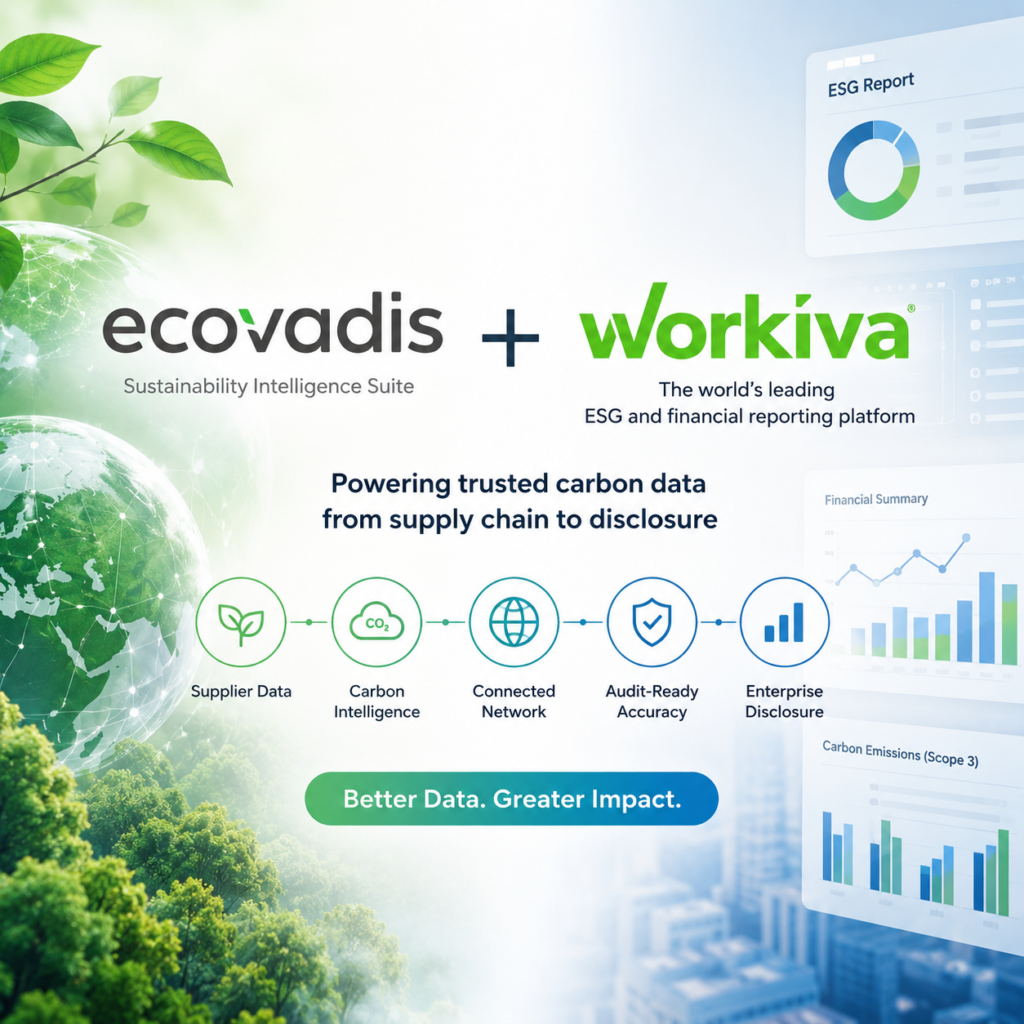
90% of global businesses still lack targets to reduce their supply chain emissions. Of the companies that do report Scope 3 figures, academic research has found that self-reported carbon footprints can understate actual output by a factor of 4 or more once methodological inconsistencies are corrected. It is against this backdrop of questionable data and growing investor scepticism that EcoVadis and Workiva announced a strategic partnership on Monday to connect primary supplier carbon emissions data with enterprise disclosure infrastructure, expanding the reach of what EcoVadis calls its Carbon Data Network.
The deal is not a typical software integration. EcoVadis and Workiva are attempting to build plumbing for a carbon data economy that barely exists yet: a system in which companies can trace emissions figures from individual suppliers through to board-level financial disclosures without relying on the broad industry averages that have made Scope 3 reporting a byword for guesswork. The partnership connects the EcoVadis Carbon Data Network directly into Workiva Carbon, centralising greenhouse gas data collection, calculation, and coordination across entire value chains. Both companies describe the output as investor-grade accuracy, a claim that will face immediate scrutiny in a market where that phrase has been liberally applied and rarely tested.
EcoVadis, headquartered in Paris, runs the world’s largest sustainability ratings network, with more than 175,000 organisations across 250 industries and 185 countries. The company functions as a primary data engine: it provides the tools that allow suppliers to measure, report, and improve their environmental performance. Workiva, listed on the New York Stock Exchange under the ticker WK, occupies a different position in the stack. Its AI-powered platform is used by more than 6,600 organisations, including over 85% of Fortune 1,000 companies, to handle financial and nonfinancial reporting in a governed, audit-ready environment. The company reported $885 million in total revenue for fiscal 2025 and has guided for roughly $1 billion in fiscal 2026. Under the terms of the partnership, EcoVadis and Workiva will divide responsibilities along those existing lines: EcoVadis collects the data, Workiva calculates and discloses it.
The timing matters, though not for the reasons most press releases would suggest. The carbon accounting software market, valued at roughly $1.8 billion in 2024, is projected to reach $14.2 billion by 2034. That growth forecast has triggered a scramble for positioning that looks increasingly like the early innings of enterprise software consolidation. Persefoni, once seen as the leading pure-play carbon accounting startup, has cut headcount by nearly half over the past 2 years. Emitwise wound down its product line entirely before being acquired by Green Project. Meanwhile, Salesforce and Microsoft have embedded carbon tracking directly into their existing cloud ecosystems, betting that carbon accounting is a feature, not a standalone product.
EcoVadis and Workiva are taking a different approach. Rather than building a single vertically integrated platform, they are assembling a network of partners that each bring distinct capabilities to Scope 3 data management. The Carbon Data Network, which sits within the broader EcoVadis Carbon Action Manager platform, now includes Sweep, Normative, Watershed, Carbmee, and Workiva. The strategy is to position EcoVadis as the supplier-facing data layer that feeds multiple carbon accounting and reporting platforms simultaneously, making the company harder to displace as the ecosystem matures.
“Meaningful climate action starts with data you can actually trust,” said Dexter Galvin, Senior Vice President of Climate at EcoVadis. “By replacing industry averages with verified supplier insights, we’re enabling organisations to master the complexities of Scope 3 emissions. This new partnership is a vital step in transforming the global supply chain from a source of carbon risk into a driver of measurable climate resilience.”
The question is whether trust can be manufactured through integration alone. A study published in Nature Communications that attempted to harmonise corporate carbon footprints across 56 technology companies found a total gap of 391 megatons of CO2 equivalents per year between reported and standardised figures. On a company level, emissions increased by a median factor of 4 after harmonisation, with deviations as extreme as 185 times the self-reported number in 1 case. The researchers pointed to a lack of methodological clarity as the root cause, a problem that better software can help address but cannot solve by itself.
EcoVadis has moved to tackle the credibility question head-on. The Carbon Data Network now assigns 1 of 4 Carbon Data Reliability Levels to all supplier-reported Scope 1, 2, and 3 metrics by cross-referencing supporting evidence, performing best-practice checks, and flagging statistical outliers. The company also launched a free Product Carbon Footprint Calculator earlier this year, available in 13 languages and covering 12 industrial sectors from plastics to electronics. The tool is aimed particularly at small and medium-sized enterprises, which dominate global supply chains by volume but have historically lacked the resources to produce credible emissions data.
Mandi McReynolds, Chief Sustainability Officer at Workiva, framed the partnership as an answer to a structural gap. “As sustainability disclosure moves from voluntary to mandatory, companies need more than carbon accounting. They need carbon data that connects to their financial data,” McReynolds said. “This partnership brings EcoVadis’ best-in-class Scope 3 supplier intelligence directly into Workiva’s platform, where it unifies with financial, risk, and sustainability data in a single audit-grade system.”
There is a financial dimension to the urgency. A report published earlier this year by EcoVadis and Boston Consulting Group estimated that climate inaction could cost companies more than $500 billion in annual liabilities globally by 2030, with Scope 3 emissions representing a primary source of exposure. Meanwhile, only 16% of the world’s largest corporations are currently on track to meet their 2050 Net Zero commitments. For procurement teams, the implication is stark: the emissions data flowing through supply chains is not just an environmental disclosure requirement but an increasingly material financial risk.
The broader carbon accounting market is watching to see whether the network model championed by EcoVadis and Workiva can outperform the vertically integrated platforms being built by competitors. Salesforce Net Zero Cloud and Workiva itself have been identified by market analysts as occupying the dominant competitive positions in the space, with their advantage resting on installed base depth and integration complexity. Persefoni and Watershed sit in the next tier, competing on technical specialisation. EcoVadis, for its part, is not a carbon accounting platform at all. It is a data network that supplies the raw material those platforms need, a distinction that could prove to be either its greatest strategic advantage or its most significant limitation.
EcoVadis and Workiva said the integration is now operational and that mutual customers can begin routing supplier-specific emissions data through the connected platforms immediately. Further partner integrations are planned. For the 175,000 businesses already in the EcoVadis network, the pitch is straightforward: the era of estimated emissions is ending, and the companies that cannot produce verifiable, supplier-level carbon data will find themselves on the wrong side of both their investors and their balance sheets.
ESG Tech Report
The go-to weekly newsletter for ESG and sustainability professionals. Trusted by 10,000+ industry leaders for authoritative, data-driven intelligence on the technology behind ESG. Join them today.