Double Materiality in ESG: What Companies Must Know for Compliance
Inside the ESG test that determines your full disclosure obligations.
The sustainability reporting regime that the European Union spent a decade building is now live, and at its core sits a concept that many boards still struggle to explain to their own audit committees. Double materiality is the principle that determines whether a company reports on a given ESG topic or ignores it entirely. Get the assessment right and you have a focused, defensible sustainability report. Get it wrong and you face either a bloated disclosure that wastes resources on irrelevant topics, or a thin one that auditors will challenge. For the thousands of companies preparing their first reports under the EU’s Corporate Sustainability Reporting Directive, the double materiality assessment is where compliance begins and where it most frequently goes wrong.
What Double Materiality Means vs Single Materiality
Most companies already conduct some form of materiality assessment, typically shaped by the ISSB standards now adopted or being finalised across 36 jurisdictions. The ISSB operates on single materiality: could this sustainability issue reasonably influence investors, lenders and creditors? If so, disclose it. If not, leave it out.
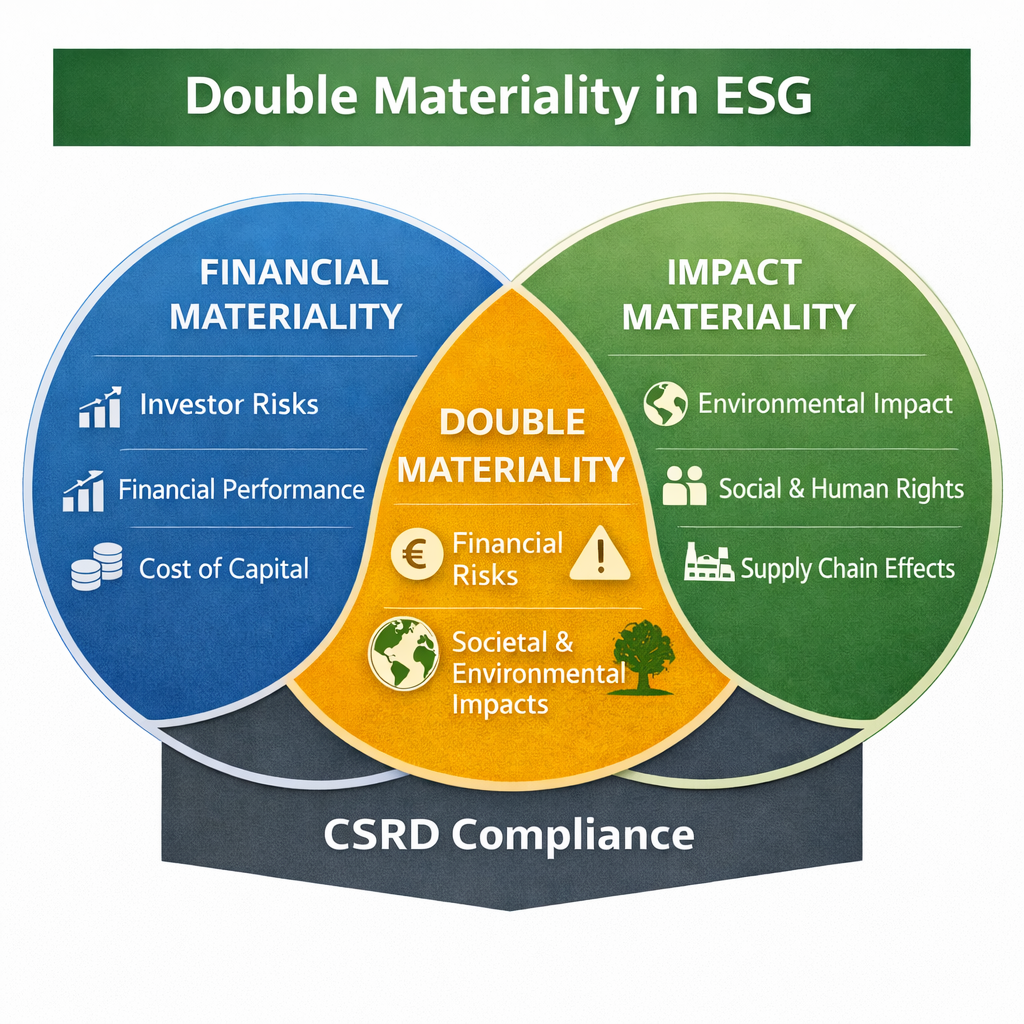
Double materiality, as codified in the European Sustainability Reporting Standards, rejects that as insufficient. It demands two distinct assessments. Financial materiality is the outside-in view: how do environmental or social factors create risks or opportunities that could affect the company’s cash flows, access to finance or cost of capital? This is essentially the same lens the ISSB uses. Impact materiality, the inside-out view, is where the CSRD diverges: how do the company’s own operations and value chain affect people and the environment? A sustainability topic becomes reportable if it clears the threshold on either dimension. It does not need to be material from both.
This distinction matters enormously in practice. Consider a large food manufacturer. Under single materiality, the company might reasonably conclude that biodiversity loss in distant sourcing regions does not yet pose a quantifiable financial risk. Under double materiality, it must assess whether its procurement practices contribute to habitat destruction regardless of the balance sheet. If the impact is severe in scale, scope or irremediability, the three criteria the ESRS uses to gauge severity, it is material and must be reported. Double materiality, in short, forces managers to confront externalities they might otherwise disclose only when investors already know about them.
How a Double Materiality Assessment Works in Practice
The practical mechanics of the assessment are more demanding than many companies anticipate. The ESRS does not prescribe a rigid methodology, but it sets out clear criteria that any defensible process must address.
For impact materiality, companies must identify all actual and potential impacts, both positive and negative, across their own operations and value chains. Each impact is assessed for severity through three components. Scale measures how grave the impact is. Scope captures how widespread it is, whether geographically for environmental impacts or by the number of people affected for social ones. Irremediable character asks whether the damage can be reversed; a toxic spill that permanently contaminates a water table scores differently from one that can be cleaned up. For potential negative impacts, severity is combined with likelihood. Critically, ESRS 1 specifies that for potential negative human rights impacts, severity takes precedence over likelihood. A low-probability event with catastrophic, irremediable consequences can still be material.
Financial materiality uses a complementary framework. Companies assess the likelihood that a sustainability-related risk or opportunity will materialise and the potential magnitude of its financial effect, including qualitative impacts such as reputational damage. Both dimensions must be evaluated across short, medium and long-term time horizons.
The company sets its own thresholds for each criterion, which is where the exercise becomes fraught. The ESRS avoids prescribing fixed quantitative cut-offs, reasoning that what constitutes a material impact for a mining company differs vastly from what matters for a software firm. But auditors will scrutinise the reasonableness of the thresholds chosen. PwC has flagged this as a common pitfall: companies that set thresholds too loosely end up with unmanageably broad disclosures, while those that set them too tightly risk compliance challenges when assurance providers disagree.
The Ten ESRS Topics and Climate’s Special Status
The ESRS lays out ten topical standards that companies must evaluate through this dual lens. Five are environmental: climate change (E1), pollution (E2), water and marine resources (E3), biodiversity and ecosystems (E4), and resource use and circular economy (E5). Four are social: own workforce (S1), workers in the value chain (S2), affected communities (S3), and consumers and end-users (S4). One covers governance: business conduct (G1).
None is universally mandatory. A company that concludes, through a documented assessment, that pollution is not material from either perspective can omit the entire E2 standard. But there is one notable exception. If a company determines that climate change is not material and excludes all E1 disclosures, the ESRS requires a detailed explanation including a forward-looking analysis of whether climate might become material in future. No other topic carries this heightened burden. It amounts to a near-presumption of materiality for climate, and early evidence from Wave 1 reporters suggests most firms are treating climate change (E1), own workforce (S1) and business conduct (G1) as material at a minimum.
CSRD Scope After the Omnibus Overhaul
The regulatory landscape shifted in December 2025 when the European Parliament approved the Omnibus I simplification package. The original CSRD was projected to capture around 50,000 companies. Under the revised thresholds, mandatory reporting applies only to EU companies with more than 1,000 employees and net annual turnover exceeding €450 million. Non-EU parent companies are caught if they generate more than €450 million of EU turnover for two consecutive years. Listed SMEs have been removed entirely, and the number of in-scope companies has fallen by an estimated 85%.
Wave 2 companies have been granted a two-year delay and will now report in 2028, covering financial year 2027. EFRAG’s simplified ESRS, finalised in December 2025, reduce mandatory data points by 61%, with the total reduction exceeding 70% once voluntary disclosures are removed.
Yet the concept’s significance has not diminished. Because all topical disclosures are now fully subject to materiality, the entire scope of a company’s reporting obligation flows from the quality of its assessment.
Why Double Materiality Reaches Beyond CSRD Scope
Even companies outside the revised thresholds will feel the effects. Reporting companies must assess impacts across their full value chains. KPMG’s 2025 ESG Assurance Maturity Index, surveying 1,320 executives at companies averaging $16.8 billion in revenue, found that 74% of Wave 1 companies reported their sustainability plans unchanged despite regulatory ambiguity. These companies will keep requesting data from suppliers regardless of what the regulation technically permits.
The practical implication is that the assessment is not something a company does once and files away. The ESRS expects it to be a living process, updated as risks change and value chain understanding deepens. For many firms, 2026 is the year to build the infrastructure: cross-functional teams spanning sustainability, finance, risk, legal and HR; stakeholder engagement processes that now ask far harder questions than the old “which topics do you consider important” surveys; and documentation systems that will need to withstand limited assurance review now and, eventually, reasonable assurance comparable to a financial audit.
Companies that treat double materiality as a compliance checkbox will produce reports that are either defensively over-inclusive or dangerously incomplete. Those that treat it as what it was designed to be, a structured method for understanding which sustainability issues genuinely affect their business and which their business genuinely affects, will find it shapes not just their disclosure but their strategy.