
Circular Economy: What It Is, Why It Matters, and How It Works
A $518 billion market growing at 11% a year. Here is what the circular economy actually means and how it works.
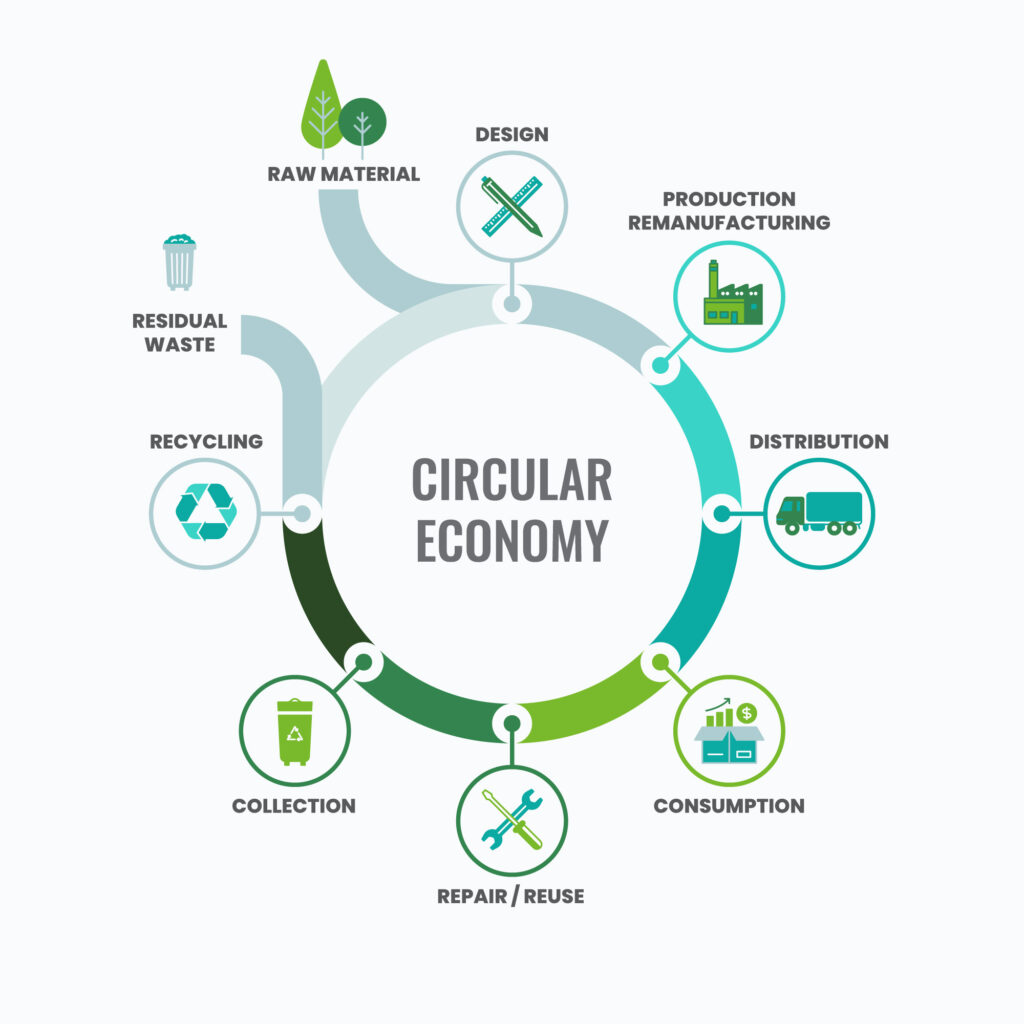
A £12 polyester top from a high street retailer will, on average, be worn seven times. Then it will be thrown away. It will sit in landfill for upwards of 200 years, slowly shedding microfibres into the surrounding soil and groundwater. The fashion industry alone generates around 92 million tonnes of textile waste a year, and every tonne follows the same path: raw materials are pulled from the earth, shaped into something, used briefly, and discarded. Economists call this the linear model. Most of us just call it shopping. The circular economy is the argument that this does not have to be how things work, and increasingly, the evidence that it cannot be.
The Basic Idea
In a circular economy, waste as we understand it does not exist. Products and materials are kept in use for as long as possible, and when they do reach the end of their useful life, they are fed back into the system as inputs for something new. Nothing goes to landfill. Everything circulates.
If that sounds like recycling, it is worth pausing on why it is not, or at least not mainly. Recycling is the last resort in a circular system, not the starting point. The real ambition sits much further upstream: can the product be repaired before it is recycled? Resold? Refurbished? Better still, can it be designed differently from the outset so the question of disposal never arises? It all begins not at the bin, but at the drawing board.
Why You Should Care Now
Before getting into how it works, it helps to understand why this idea has moved so quickly from academic theory into corporate strategy and government regulation. Two forces are converging, and neither is going away.
The first is risk. Companies that depended on cheap, abundant raw materials watched their supply chains buckle during the pandemic, buckle again during energy market disruptions, and buckle again as trade tensions escalated. The World Economic Forum’s 2026 Global Risks Report ranks natural resource shortages among the top threats of the coming decade. A system built on extracting finite materials from a handful of countries turns out to be fragile in ways that are expensive to discover.
The second is regulation. The EU’s Packaging and Packaging Waste Regulation takes effect in August 2026. The Ecodesign for Sustainable Products Regulation will require manufacturers of textiles, electronics, and furniture to account for full product lifecycles. Digital product passports, QR-coded records of a product’s composition, carbon footprint, and recycling instructions, become mandatory for batteries in 2027, with textiles shortly after. If you sell into European markets, these are not abstract policy ideas. They are deadlines.
Together, these pressures have turned the circular economy from a worthy aspiration into a commercial and regulatory reality. The global market was valued at roughly $518 billion in 2025 and is growing at over 11% annually. But what matters is not the number. It is the direction. So how does this actually work?
How It Works: Three Principles
The Ellen MacArthur Foundation, the UK organisation that has done more than any other to define the framework, breaks the circular economy into three principles. The clearest way to understand them is to see each one in action.
Design Out Waste and Pollution
Most waste is not inevitable. It is a design choice. Consider a pair of trainers glued together from six different materials: the sole bonded to the upper, the foam fused to the fabric. No sorting facility on earth can separate those materials economically. That shoe is going to landfill regardless of how conscientiously you try to dispose of it.
Now consider what Ikea did with its Billy bookcase, one of the bestselling pieces of furniture in history. The company recently re-engineered it so it can be taken apart and repaired more easily. That is the first principle in action: solving the waste problem before the product ever reaches a shop floor. Waste is not created when you throw something away. It is created when someone designs something that cannot be used again.
Keep Products and Materials Circulating
Once a product exists, the goal is to preserve as much of its value as possible for as long as possible. Repair preserves the most. Resale and refurbishment come next. Remanufacture, where components are stripped out and rebuilt into new products, follows. Recycling comes last, and even then, the aim is to maintain material quality rather than degrading it into something inferior. That degradation has a name: downcycling. Think of a glass bottle melted and remade into a new bottle, versus the same glass crushed into aggregate for road fill. Same material. Vastly different value.
Patagonia’s Worn Wear programme shows what this looks like at scale. Customers trade in used outdoor clothing for credit. Patagonia cleans, repairs, and resells those garments at lower prices, keeping each item in use for years longer than it otherwise would be. Ikea runs a parallel model with furniture: you return what you no longer need, and it gets resold, repaired, or recycled. In both cases, the product keeps moving rather than stopping at a skip.
Regenerate Natural Systems
The third principle is the one most people overlook, and it is arguably the most radical. It goes beyond reducing harm and into actively restoring what has been damaged.
Here is a number that puts the problem in perspective: less than 2% of the valuable nutrients in food waste and byproducts are currently recycled back into productive use. The rest rots in landfill, where it decomposes without oxygen and produces methane, a greenhouse gas roughly 80 times more potent than carbon dioxide over a 20-year period. That is not just a waste of food. It is a waste of the nutrients that could be rebuilding the soil we grow food in.
A circular economy approach treats that food waste not as rubbish but as a resource. Composting it and returning it to farmland closes a nutrient loop, rebuilding soil health, improving water retention, and reducing the need for synthetic fertilisers. Some companies are going further: turning spent coffee grounds into biofuel, converting brewery grain into animal feed, processing surplus bread into beer. These are not novelty projects. They are the beginning of a food system that gives back to the land rather than just taking from it.
The Radical Version
Those three principles can be applied gradually, as Ikea and Patagonia are doing. Or they can be pushed to their logical conclusion: what if you never owned the product at all?
Signify, formerly known as Philips Lighting, sells light as a service. The company retains ownership of every fitting, installs and maintains it, and recovers it when the contract ends. You pay for illumination, not for a physical product. This inverts the incentive structure entirely. Signify profits from durability and efficiency, not from selling replacements. It has no commercial reason to engineer obsolescence, because obsolescence costs it money. It is a circular economy business model in which the company’s financial interests and the planet’s interests finally point the same way.
What Is Standing in the Way
If all of this sounds logical, you may wonder why it has not happened faster. The obstacles are both structural and personal, and the personal ones are worth stating first because they are the ones you run into before anything else.
Try getting a cracked phone screen repaired affordably. Try finding replacement parts for a three-year-old washing machine. Try taking apart a piece of flatpack furniture without destroying it. Much of what we buy is still deliberately designed to be difficult or impossible to repair, because manufacturers profit from replacement, not from longevity. The “right to repair” movement across Europe is pushing back, but progress is slow and uneven.
At a structural level, recycled materials frequently cost more than virgin alternatives, particularly when the environmental damage of extraction is not priced into the market. Collection and reprocessing infrastructure remains patchy outside northern Europe. And while the EU is tightening its circular economy framework, the United States has loosened environmental disclosure rules, creating a policy divergence that makes long-term planning difficult for any business operating across both markets.
Where This Leaves You
The circular economy is not a trend, a buzzword, or a marketing exercise. It is a structural reorganisation of how economies will need to work within the physical limits of a planet running out of room to absorb the consequences of the linear model.
The next time you throw something away, notice that there is no “away.” There is only somewhere else. The circular economy starts with taking that seriously.
ESG Tech Report
The go-to weekly newsletter for ESG and sustainability professionals. Trusted by 10,000+ industry leaders for authoritative, data-driven intelligence on the technology behind ESG. Join them today.