Canada Lists 19 Approved Suppliers for Carbon Removal Procurement
Ottawa set up a national standing offer on November 19 for 19 carbon removal projects, which federal departments can buy from until March 2029.
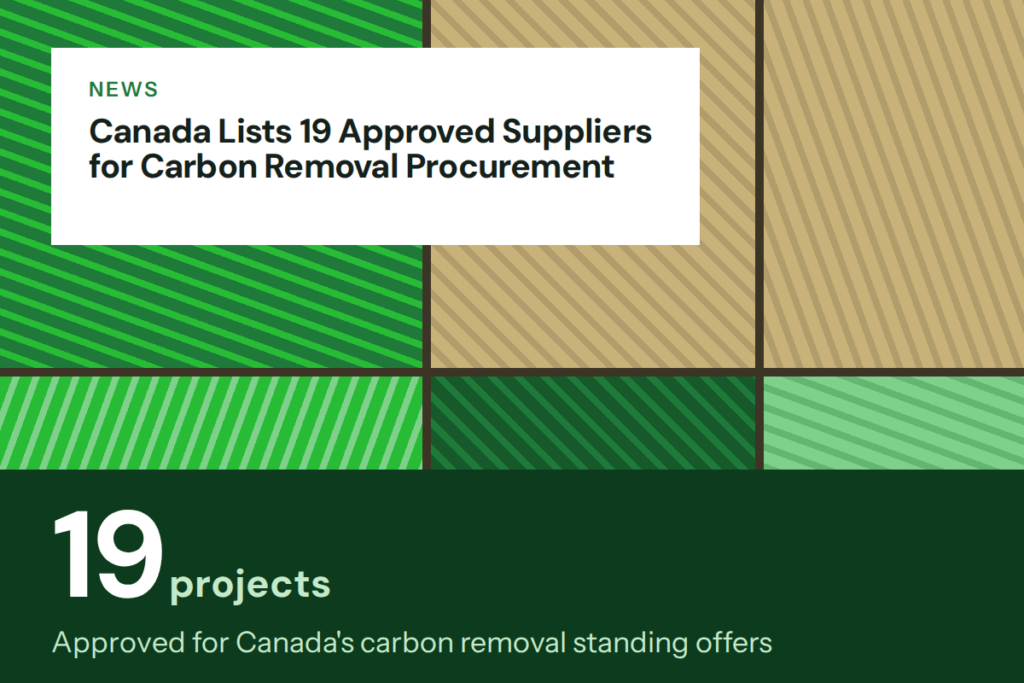
The Treasury Board of Canada Secretariat announced on November 19, 2026 a national master standing offer that gives federal departments access to carbon dioxide removal credits from 19 projects, in a Canada carbon removal procurement that runs until March 31, 2029.
For sustainability and finance teams, the programme matters less for its size, which has not been published, than for its design. A national government has set a competitive, pre-qualified route for buying permanent removals, and its choices on verification, project categories and call-up rules give corporate buyers a template. Those buyers include companies in the EU, the UK and the US that are preparing their own removal purchases alongside carbon credit strategies.
The offers follow an October 2024 commitment to buy at least $10 million of carbon dioxide removal services by 2030. They also sit inside the federal goal of net-zero emissions from government operations by 2050.
What the Canada Carbon Removal Procurement Covers
The Treasury Board said the offers give departments access to credits from 19 projects across Canada, and described Canada as the first national government in the world to establish competitive standing offers for permanent removal credits. Departments can use the offers until March 31, 2029, with an option to extend to March 31, 2031.
The 19 offers come from 17 distinct companies, because Deep Sky and Cariboo Carbon Solutions each have two. The projects fall into five categories: direct air capture with permanent storage, bioenergy with carbon capture and storage (BECCS), biochar, other biomass storage and enhanced mineralisation. Four of the successful applicants had previously received funding from Natural Resources Canada’s Energy Innovation Program.
A standing offer is not a contract under Canadian procurement rules. Departments must issue individual call-ups before any purchase becomes binding, so the list establishes who can sell to Ottawa but not how many tonnes it will buy or at what price. Neither the credit volumes nor the prices have been published.
“These new carbon dioxide removal credit standing offers demonstrate Canada’s leadership in climate action” Shafqat Ali, President of the Treasury Board
The Approved Suppliers by Removal Method
Three direct air capture offers cover projects in Alberta and Quebec. Baie Minerals is listed for its Atlantic Carbon Mineral Hub in Newfoundland and Labrador, while Deep Sky has two projects, Deep Sky Alpha in Alberta and Deep Sky Black Lake in Quebec, and Skyrenu Technologies has its Orford Project in Quebec.
The BECCS group has three entries. North Star Carbon Solutions LP is in Saskatchewan, pHathom Technologies is in Nova Scotia and Remova Carbon Systems is in Alberta with a forestry-based project. North Star is a partnership between the Meadow Lake Tribal Council and Svante Technologies.
Biochar has five offers: Anew Climate in Ontario, Carbon Lock Tech in Manitoba, Carbonity in Quebec, and Cariboo Carbon Solutions and Safi Enterprises in British Columbia. The other biomass storage category has four: a second Cariboo project on Vancouver Island, NULIFE GreenTech in Saskatchewan, Vaulted Deep in Alberta and a forest biomass project from the Pessamit Innu First Nation in Quebec.
Enhanced mineralisation closes the list with UNDO Carbon Canada and Karbonetiq in Ontario, and Arca in Quebec. Every project is based in Canada, as the eligibility rules require removal and storage to happen in the country.
Verification Rules Behind the Procurement
For carbon removal procurement in Canada, the Treasury Board said the selected projects must follow scientific protocols and undergo independent verification and certification aligned with international best practice. It did not publish the protocols, the minimum storage durations or the monitoring requirements in the announcement, so buyers cannot yet compare the standard against the registries they already use.
That gap matters because the category labels differ in permanence. Direct air capture with geological storage and mineralisation are generally treated as durable, while biochar and biomass storage carry more varied durability and reversal risks. The federal wording refers to storage in natural reservoirs and products, which covers both.
The announcement also does not say whether purchased credits count toward Canada’s national greenhouse gas inventory or only toward federal operations. The stated purpose is the second: offsetting hard-to-abate emissions from government activity, such as National Defence’s air and marine fleets. Corporate teams should treat the inventory question as open.
The Minister of National Defence, David J. McGuinty, said that “integrating carbon dioxide reduction solutions will lower the impact of our fleets on the environment”. The wording points to a buyer whose residual emissions come mainly from aircraft and ships, where fuel switching is slow.
How Carbon Removal Procurement in Canada Fits Policy
The 2024 commitment ran through the Low-Carbon Fuel Procurement Programme, an eight-year, $134.9 million initiative to cut emissions from federal air and marine operations. Then Treasury Board President Anita Anand said the government was adopting “carbon removal solutions to ensure we reach our goal to be net-zero emissions by 2050”. The new offers are the first operational step, and the Treasury Board said the results will inform its long-term strategy on carbon dioxide removal for greening operations.
The $10 million floor is small beside the programme it sits in, and small beside private buyers. Ottawa’s value is therefore in the signal and the structure, which give early-stage developers a government counterparty and a documented qualification process that private offtakers and lenders can reference.
The programme also shows how a buyer can keep removals separate from carbon accounting for emissions cuts. Departments will still have to report operational emissions first, and the credits address only the residual share.
How Canada Compares With Other Removal Buyers
The US Department of Energy took a different route with its Carbon Dioxide Removal Purchase Pilot Prize, which offered up to $35 million in cash awards in the form of credit purchase agreements. Its Phase 1 stage named 24 semifinalists in May 2024 and moved winners towards contracts with measurement, reporting and verification terms. Canada’s approach is a standing offer open to departments over several years, while the US pilot was a prize with a fixed pool.
Frontier, the advance market commitment launched in April 2022, works through offtake agreements on behalf of its members. It began with $925 million pledged by Stripe, Alphabet, Shopify, Meta and McKinsey, and its commitments now exceed $1 billion, according to its progress page. Frontier signs multi-year offtakes with named developers, so unlike Canada’s list it commits money to specific tonnes.
Microsoft is the largest single private buyer. The company said it signed agreements to remove a record 45 million tonnes of carbon dioxide in its 2025 fiscal year, with 21 companies, and it has described its approach as a portfolio across many removal types. It has also said it may adjust the pace or volume of its removal procurement at times.
Next to these buyers, the offer for carbon removal procurement in Canada is modest in size but unusual in form. It prequalifies suppliers across five removal categories, relies on domestic storage and leaves volume to individual departments, which could suit procurement teams that want a vetted list before negotiating.
What Buyers Should Take From the Procurement
Corporate teams can borrow three elements. The first is category-level qualification, which lets a buyer compare like with like across biochar, mineralisation and direct air capture. The second is independent verification as a condition of listing, not a later check. The third is separating the right to buy from the commitment to buy, which preserves flexibility while projects are still being built.
The programme also arrives as California’s SB 253 and other disclosure rules push large companies to document their emissions and any claimed offsets or removals. Teams that plan to buy removals will need contract terms on permanence, reversal and registry retirement that stand up to assurance, which is the kind of detail Ottawa has not yet published. The growth in emissions reporting software reflects the same need for traceable data.
The first real test will be the call-ups. Federal departments can issue them from now until March 31, 2029, and the volumes, prices and delivery dates in those orders will show how much of the list Ottawa actually buys from.
ESG Tech Report
The go-to weekly newsletter for ESG and sustainability professionals. Trusted by 10,000+ industry leaders for authoritative, data-driven intelligence on the technology behind ESG. Join them today.