EU and UK Complete Talks on Linking Carbon Markets
The EU and UK concluded talks on linking their emissions trading systems, targeting 1 January 2028 and mutual CBAM exemptions for covered goods.
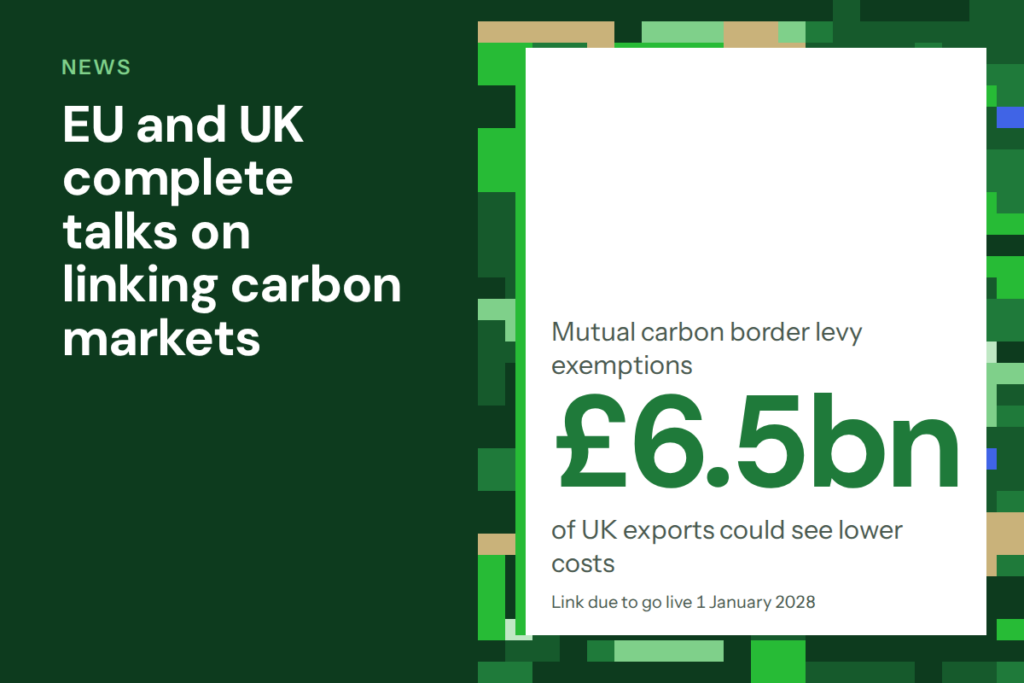
The EU and UK concluded negotiations on 20 November to link their emissions trading systems, so allowances can be used for compliance in both markets from 1 January 2028. The EU ETS carbon price and the UK allowance price are expected to move closer together as a result.
For sustainability and finance teams, the link changes how carbon costs are budgeted, hedged and reported on both sides of the Channel. It also removes a trade cost, because the two governments plan mutual exemptions from their carbon border levies, which the UK government says could reduce costs on £6.5 billion of UK exports.
The UK government set out the terms in an explainer on the linking agreement. The EU Council had authorised the European Commission to open talks in November 2025.
EU ETS Carbon Price Link: What Changes in 2028
The target go-live date is 1 January 2028, after which allowances from either system can be surrendered for compliance in either. The first joint surrender deadline is 30 September 2028, covering 2027 scheme-year emissions, and free allocation will be issued on 30 June each year from 2028.
A new Joint Committee on ETS Linking will meet at least every six months and decide by mutual consent. It must also agree detailed technical standards before the two registries connect, and an independent arbitration panel will resolve disputes.
The UK is widening its own scheme to match. From 1 January 2028 it will cover 50% of emissions from international voyages by ships of 5,000 gross tonnage and above, while domestic voyages stay at 100%. Waste incineration plants of 20 MW or more face mandatory monitoring and reporting from the same date, and landfill is excluded.
Companies running carbon accounting processes should expect the scope changes to reach their data collection. Shipping and waste operators in particular will need verified emissions data that did not previously feed a compliance obligation.
How the EU ETS Carbon Price and UK Allowances Converge
The UK government says linking the EU ETS will contribute to convergence of carbon prices, but it has not published a price forecast. Several design changes show how the two markets are meant to line up, and none of them fixes a price.
The UK removes its Auction Reserve Price, the floor that has supported UK allowances, when the link goes live. It also adopts the EU’s price-spike mechanism, under which the EU releases 75 million allowances if its six-month average auction price exceeds 2.4 times the two-year reference average, and the UK releases 5 million from its own reserve.
That UK Market Stability Reserve starts in 2028 with 29.5 million allowances and rises to 34.5 million by 31 December 2032. Its intake and releases are set at 6.7% of the EU reserve’s amounts.
The UK cap is tied to the EU’s as well. UK issuance is limited to 62.2 million allowances in 2028, 59.5 million in 2029 and 57.6 million in 2030, and from 2031 it is capped at 7.1% of the equivalent EU cap, plus allowances for any expansion in scope.
Existing UK allowances can be banked, and borrowing is allowed within a phase but not between phases. International credits remain barred from UK compliance. Treasury teams that hedge both markets should plan for a narrower gap between UK allowance prices and the EU ETS carbon price, although the speed of that narrowing is not specified. The government estimates the link will add up to £3.8 billion a year to the UK economy by 2040.
Industry bodies welcomed the deal. The Carbon Capture and Storage Association said the link opens a shared economic opportunity.
“We warmly welcome the agreement to link the EU and UK Emissions Trading Systems.” Olivia Powis, Chief Executive Officer, Carbon Capture and Storage Association
CBAM Exemptions on Both Sides
The two governments will exempt goods originating in each other’s territory from their carbon border adjustment mechanisms once the link is fully operational. The exemptions are mutual, but they do not start together.
The EU exemption is expected from 1 January 2028 and depends on EU legislative procedures that the EU will launch without delay. The UK intends to exempt goods from the EU, the European Economic Area and Switzerland from 1 January 2027, when its own border levy starts.
In return, the UK will align with the EU’s phase-out of free allocation for products covered by the EU levy from 2028. Those products are iron and steel, aluminium, cement, fertilisers and hydrogen. Either side can suspend the mutual recognition of allowances or the exemption with written notice, after which the Joint Committee must meet within 10 days.
Importers and exporters of those goods should keep their embedded emissions data current through 2027, because the UK exemption arrives a year before the EU one. The data work also feeds wider ESG reporting data governance programmes, since the same product-level figures support customer and regulatory requests.
CO2 Storage Rules Under the EU ETS Link
The agreement also covers captured carbon. The UK and EU intend to allow permanent CO2 storage in each other’s territory from 2031, subject to changes in EU law.
From 2028 the UK aligns with the EU CCS Directive, including its scrutiny process for storage permits. UK installations can deduct CO2 sent to any UK store that holds an EU-style storage permit, and CO2 moved by ship, train or truck counts for deduction as well as pipeline transport. Operators must monitor emissions from boosters, liquefaction, venting, fugitive releases and leakage.
The UK government says the deal lets it capture commercial opportunities in cross-border CO2 transport and storage. It does not name which UK or North Sea storage operators would gain, and the explainer does not say how individual projects would be treated.
The Carbon Capture and Storage Association estimates EU industrial emitters could save an average of $12.07 (€11) a tonne, and some could cut offshore transport and storage costs by up to 28%, about $17.55 (€16) a tonne. It puts the benefit to the UK at $5.26 billion (£4 billion) in annual export revenues and $9.21 billion (£7 billion) in investment by 2040. The association also wants EU recognition of third-country storage under the EU ETS by 2029.
The UK also plans to integrate greenhouse gas removals by the end of 2029, earlier than the EU’s proposed 2031 start, with high-quality UK woodland left out of the initial phase. Companies weighing offsets against removals can find the basics in this guide to carbon credits.
The International Emissions Trading Association also backed the link, arguing that it deepens liquidity.
“No single market can deliver net zero alone.” Dirk Forrister, President and Chief Executive Officer, IETA
Compliance Costs and the Wider Market
Free allocation rules tighten for UK installations. The new entrant reduction factor falls to 0.9130 in 2028, 0.8690 in 2029 and 0.8250 in 2030, and the process emissions factor moves from 0.97 to 0.91. Installations in the least efficient 20% of their benchmark must file a climate neutrality plan by 30 June 2028 or lose 20% of their free allocation for 2028 to 2030.
The UK will also apply the same cross-sectoral correction factor as the EU if the EU applies one. The most efficient 10% of installations will be exempt from future use of that factor, based on combined UK and EU data from 2031.
For finance teams, the EU ETS carbon price will matter more for UK-based operators once the markets share a single compliance pool. That raises demand for tools that track allowance positions and emissions data together, a segment covered in the forecasts for carbon software growth.
Ratification Steps Still Ahead
The conclusion of talks is not the end of the process. The UK will lay secondary legislation to implement the agreement and publish an impact assessment, and an assessment for the wider summit package will accompany the European Partnership Bill. On the EU side, the CBAM exemption requires EU legislative procedures, and the Council of the EU must endorse the agreement before it enters into force.
Termination is possible on 18 to 30 months’ notice, depending on timing, and it also follows if the Trade and Cooperation Agreement ends unless both parties agree otherwise. The UK has also set 31 December 2026 as the deadline for waste incineration operators to apply to continue voluntary reporting for the remaining period to end-2027.
The next milestone is the UK’s planned CBAM exemption for EU goods on 1 January 2027, a year before the link is due to go live.
ESG Tech Report
The go-to weekly newsletter for ESG and sustainability professionals. Trusted by 10,000+ industry leaders for authoritative, data-driven intelligence on the technology behind ESG. Join them today.