European Commission Drafts Biogenic Carbon Storage Certification
The European Commission is taking comments until 10 December 2026 on its first CRCF methodology for carbon stored in products, starting with buildings.
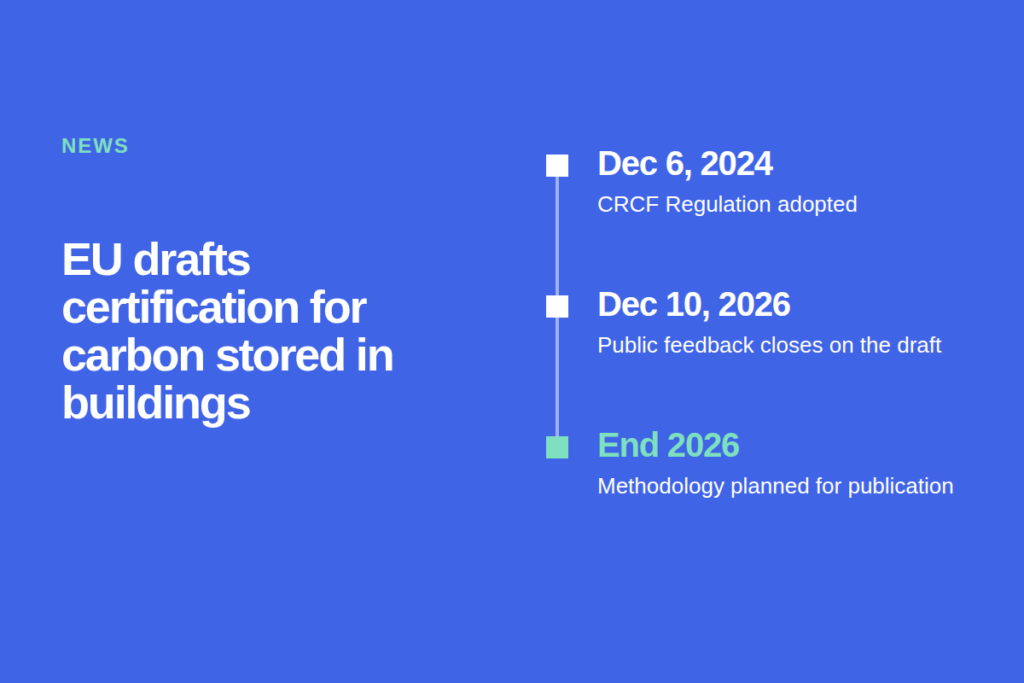
The European Commission has opened public feedback on a draft methodology to certify biogenic carbon stored in buildings made with sustainably sourced timber or agricultural crops, with comments due by 10 December 2026.
The voluntary scheme targets building owners, developers and product manufacturers. Comments go through the Commission’s Have Your Say portal. It is the first certification methodology the European Commission has proposed for carbon storage in products.
For sustainability and finance teams in construction, real estate and building materials, the draft would create an EU-recognised way to document carbon held in a building’s structure. Today that figure sits in project-level life cycle assessments and carbon accounting models with no common certification behind it.
The Commission has not given an adoption date, scope thresholds or liability terms for the buildings methodology. Its certification page says the methodology is planned for publication by the end of 2026.
What the European Commission draft covers
The draft focuses on bio-based construction products, such as timber or agricultural crops. The Commission says carbon absorbed during biomass growth stays stored in the building throughout its lifetime. Bio-based products can therefore help create buildings that act as long-term carbon reservoirs.
The certification aims to recognise building practices that demonstrate carbon storage credibly. It also seeks to align construction activity with circular bioeconomy principles.
The Commission’s certification page defines carbon storage in products as capturing and storing CO2 for at least 35 years in long-lasting products. The building blocks of the buildings methodology sit in a technical assessment paper dated December 2025.
Three groups are affected. Owners and developers could showcase the climate performance of buildings that store carbon in bio-based materials. Timber and crop-based product makers supply the stored carbon, provided their materials are sustainably sourced. Certification schemes must apply the methodology so that certified storage is robust, credible and durable.
How the CRCF Regulation certifies carbon storage
The buildings draft sits under the Carbon Removals and Carbon Farming (CRCF) Regulation, adopted on 6 December 2024. It is the first EU-wide voluntary framework for certifying carbon removals, carbon farming and carbon storage in products.
The Commission adopts each methodology as a Delegated Act, a form of secondary EU law. These acts set detailed rules that operators must meet under the regulation’s quality criteria: quantification, additionality (benefits beyond existing practices), storage, monitoring and liability, and sustainability.
The buildings draft follows methodologies already adopted for two other activities. Delegated Regulation (EU) 2026/285 covers permanent carbon removals through direct air capture with storage, bioenergy with carbon capture and biochar. The Commission adopted a further Delegated Regulation in July 2026 covering carbon farming, including agriculture and agroforestry on mineral soils, peatland rewetting and restoration, and afforestation.
Buildings are the first test of how the framework treats storage in products rather than in soils, forests or geological formations.
Certification schemes and the European Commission review
Methodologies only matter if schemes can apply them. The European Commission is assessing applications from nine certification schemes seeking recognition under the CRCF Regulation. It is judging them against the regulation, the relevant methodologies and the minimum requirements in Implementing Regulation (EU) 2025/2358, published around 1 December 2025.
Schemes must hold mandatory public consultations, keep internal monitoring systems and maintain complaint-handling procedures. Only certification bodies recognised by national authorities or accredited by a National Accreditation Body can carry out third-party verification audits. Recognition decisions are valid for five years.
Information must be made available on the Union Registry by 2028. The Commission’s certification methodologies page lists the adopted acts and the buildings methodology as it develops.
What the draft means for building carbon reporting
The draft leaves several questions that reporting teams will want answered before they budget for certification. The Commission’s published material does not say how certified storage would be treated in corporate Scope 3 inventories, in product-level declarations or under the EU Taxonomy. Nor does it set out how end-of-life and reuse of timber and crop-based components would be handled once a building is demolished or renovated.
Those gaps matter because biogenic carbon is already a live issue in building assessments. Companies that report under the Corporate Sustainability Reporting Directive account for emissions from construction and purchased materials, and a certified storage figure would sit alongside those emissions rather than replace them.
Manufacturers face a related data question. Product-level information requirements under the EU Digital Product Passport mean material origin and sustainable sourcing evidence will need to travel with the product. Timber and crop suppliers that can already document sourcing are better placed to feed a certification scheme.
Developers and owners should treat the 35-year storage definition as the benchmark for how long a building must hold its bio-based carbon. Any building design with a shorter expected service life, or components likely to be removed early, sits close to the line the Commission has drawn.
Why the draft matters for supply chains
Most of the stored carbon the draft would certify originates upstream, in forestry and farming. A developer cannot certify a timber frame without evidence of where the wood grew and how it was managed.
That puts supplier data at the centre of any claim. Procurement and sustainability teams already working on supply chain sustainability will find the same sourcing records feed both regulatory reporting and voluntary certification.
Crop-based materials such as straw and hemp are named by the Commission only as agricultural crops used as construction materials. The consultation will show how the Commission treats those materials against timber, which has a longer track record in building codes and life cycle assessment.
What comes next for the European Commission draft
Feedback closes on 10 December 2026. The Commission plans to publish the buildings methodology by the end of 2026, after which it would be adopted as a Delegated Act.
Watch for three things in the final text: how storage duration beyond 35 years is monitored, how liability is assigned if a building is demolished early, and whether the Commission links certified storage to building-level carbon reporting. Recognition decisions on the nine pending certification schemes are the next gate before any buildings certificate can be issued.
ESG Tech Report
The go-to weekly newsletter for ESG and sustainability professionals. Trusted by 10,000+ industry leaders for authoritative, data-driven intelligence on the technology behind ESG. Join them today.