CDP Finds 69% of Supply Chain Emissions Projects Are Profitable
CDP analysis of 12,387 emissions projects finds 69% are profitable with a median payback of three years, yet more than 12,000 suppliers have not started.
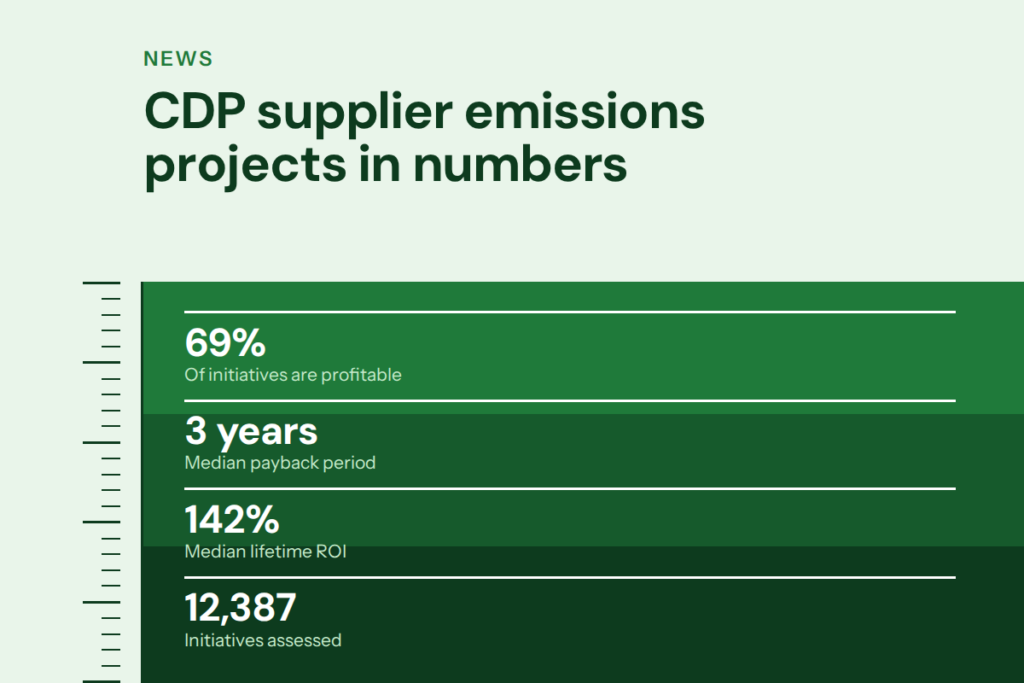
CDP, the non-profit that runs the world’s largest corporate environmental disclosure system, found that 69% of emissions reduction projects reported by companies in 2025 are profitable, with a median payback of three years, in a CDP supply chain emissions report published this week.
The finding matters to finance and procurement teams because the usual objection to Scope 3 work is cost. CDP’s data points the other way: a typical project returns about 142% over its lifetime, so the budget request looks more like a capital project with a payback schedule than a compliance expense. Yet CDP says more than 12,000 companies have not started a single project with a buyer in its supply chain programme.
Because the analysis comes from CDP, which depends on companies disclosing through its platform, readers should weigh it as research from an organisation with a stake in more reporting. The figures rest on company disclosures that CDP filtered for data quality, not on independent audits of each project.
What the CDP supply chain emissions report measured
The profitability analysis draws on 2025 disclosures to CDP. According to CDP’s Disclosure Dividend 2026, more than 8,000 large and mid-sized companies reported active emissions reduction initiatives, and the return on investment analysis used a subset of over 4,400 companies that supplied the financial data needed to judge profitability.
That subset covers 12,387 initiatives. CDP counts an initiative as profitable when it generates positive lifetime net savings, and 41% of the initiatives pay back in under three years. The 142% return is a median lifetime figure and is undiscounted, so it does not account for the time value of money, which a controller applying a hurdle rate will want to adjust.
A separate CDP analysis of monetary savings covered 21,241 initiatives across 6,569 organisations. It found aggregate savings of $40.7 billion, which fell to $27.6 billion after CDP applied stricter data-quality filters. CDP does not publish a sector breakdown for the profitability sample, so the headline numbers describe the pooled dataset and not any single industry.
The supply chain emissions element of the report comes from CDP’s supply chain programme, in which buyers ask their suppliers to disclose. Of the companies that disclosed in 2025, 5,277 reported carrying out emissions reduction initiatives as a result of engagement with a member of that programme, and together they cut 127.6 million tonnes of CO2e.
Which projects pay back fastest
Returns vary by type of project. Waste reduction and material circularity projects return $3.9 for every dollar invested, with a median payback of 1.3 years, according to CDP. Energy efficiency in production returns $3.6 per dollar with a median payback of 2.1 years, and CDP puts the median ROI of those energy measures at 264%.
Across all project types, CDP says every dollar invested generates an average of $2.4 in return, and up to $7 over a project’s lifetime. These are the kinds of projects that a supplier’s operations team can usually run without waiting for new technology, for example upgrading motors and boilers or cutting scrap in a production line.
Buyers have some evidence of what this looks like in practice. Diageo has more than 60 supplier initiatives that CDP estimates save about 90,000 tonnes of CO2e a year, and it requires suppliers to track and share emissions data, with progress checked on a quarterly scorecard. At ANTA Sports, over 1,000 suppliers have joined decarbonisation initiatives, 130 have installed renewable energy systems and 270 have adopted renewable electricity or green certification.
Why supply chain emissions projects stall
Scope 3 emissions typically account for around 80% to 90% of a company’s footprint and are on average 26 times larger than Scope 1 and 2 emissions, CDP’s earlier analysis of supply chain data found. Despite that, only 15% of the companies reporting emissions initiatives target their value chains. CDP also says most sectors report only a fraction of their supply chain emissions, typically 22% or lower, because primary data is hard to collect or companies rely on weak emission factors.
The suppliers that have not acted give a consistent reason. Many told CDP that a lack of internal resources, capabilities and expertise is the biggest barrier to implementation. That points to the practical problem behind the profitability numbers: a project with a three-year payback still needs someone to scope it, fund it and measure the saving.
Budget ownership is the part of that problem most finance teams will recognise. A supplier’s energy project sits in the supplier’s capital plan, while the buyer’s sustainability team holds the target and the buyer’s procurement team holds the relationship, so no one’s budget carries the cost of getting the project started. Where a buyer’s own ESG data gaps already make supplier emissions hard to see, the commercial case never reaches the person who could approve it.
CDP found almost 2,900 other companies that identified opportunities to work with buyers on cutting emissions, which it estimates could reduce CO2e by a further 711 million tonnes over the lifetime of the interventions. Those are projects that suppliers have already named but not yet started with a customer.
What buyers can do with the CDP findings
Simon Fischweicher, CDP’s chief customer success officer, framed the result as a change in how buyers should think about supplier requests.
“For too long, tackling supply chain emissions has been seen primarily as a cost imposed by customers on their suppliers. The data tells a different story: suppliers’ emissions-reduction initiatives are generating financial returns, while still helping customers meet environmental goals and strengthen their supply chain resilience.”
Simon Fischweicher, Chief Customer Success Officer, CDP
Fischweicher added that targets alone will not deliver the transition, and that buyers have significant influence through the expectations they set, the data they request and the support they provide. For procurement teams, that suggests sorting supplier requests by payback instead of by tonnage, starting with energy efficiency and waste projects where the median payback is under three years.
Large buyers are already moving in that direction. Tesco asked 400 key suppliers to join the OpenClimat emissions programme, and platforms such as EcoVadis and Watershed now pair supplier ratings with Scope 3 data. Both approaches put the data request and the support in one place, which addresses the resource gap that suppliers cite.
The wider case for treating supplier work as a financial decision is set out in ESG Tech Report’s guide to why supply chain sustainability is rising on the corporate agenda. For teams building a supplier programme from scratch, the basics of carbon accounting and how companies measure emissions remain the starting point, because a payback calculation is only as good as the baseline behind it.
How to read the CDP supply chain emissions report
Three limits apply when using these numbers in a business case. First, the sample is companies that chose to report project finances to CDP, so firms with weaker results may be under-represented. Second, the figures are lifetime and undiscounted, which flatters long-lived projects relative to a discounted calculation. Third, CDP does not break the profitability sample down by sector, so a manufacturer should test its own project costs before assuming the median applies.
Even with those limits, the direction is clear enough to change the question a finance team asks. Instead of whether Scope 3 work can be afforded, the useful question is which supplier projects clear the company’s own payback threshold, and who in the business owns the budget for the first one.
What comes next for Scope 3 reporting
The pressure to produce supply chain data is rising on several fronts. California’s SB 253 requires large companies doing business in the state to report Scope 1 and 2 emissions first and Scope 3 emissions from 2027, and the ISSB’s IFRS S2 standard already asks for Scope 3 disclosure in the jurisdictions that have adopted it.
For buyers, the next concrete step is the 2027 Scope 3 filing cycle under SB 253, which will test whether companies can turn supplier disclosures into numbers they can defend. Those that already hold a pipeline of costed supplier projects will have both the data and the case for funding them.
ESG Tech Report
The go-to weekly newsletter for ESG and sustainability professionals. Trusted by 10,000+ industry leaders for authoritative, data-driven intelligence on the technology behind ESG. Join them today.